Why This Matters More in Toronto Than People Expect
A midsummer sunrise here lands well before six in the morning, and an east-facing bedroom gets the full force of it. If there are young kids in the house, that is the difference between a 7 a.m. start and a 5:30 one, every day from May through August. Winter is a quieter version of the same problem. The mornings are dark, but the nights are bright — snow throws streetlight back up at the windows, and a bedroom facing a road collects headlights across the ceiling. Shift workers and light sleepers notice it far more than anyone else in the house does. So the honest goal is rarely “total darkness.” It is: dark enough that the room does not tell you what time it is.
What “Blackout” Actually Means
The word gets used for three different things, and they are not equivalent. Blackout fabric is woven or coated so that light does not pass through it. Hold it up to a window and you see a solid shape, no glow. Blackout lining is a separate opaque layer sewn behind a face fabric you actually like. It gets a section of its own below, because it is the part most people have never been offered. Room darkening is a lighter version of both. It cuts a lot of light and softens what is left, without going fully opaque. For a bedroom where you want to sense morning without being woken by it — or a guest room, or a nursery where a little ambient light is welcome — room darkening is often the more liveable choice. It is a real category, not a watered-down one. What none of the three can do on its own is close the space around the curtain. Which brings us to the part that actually decides whether the room goes dark.
Where the Light Really Gets In
Four places, in roughly the order they cause trouble.
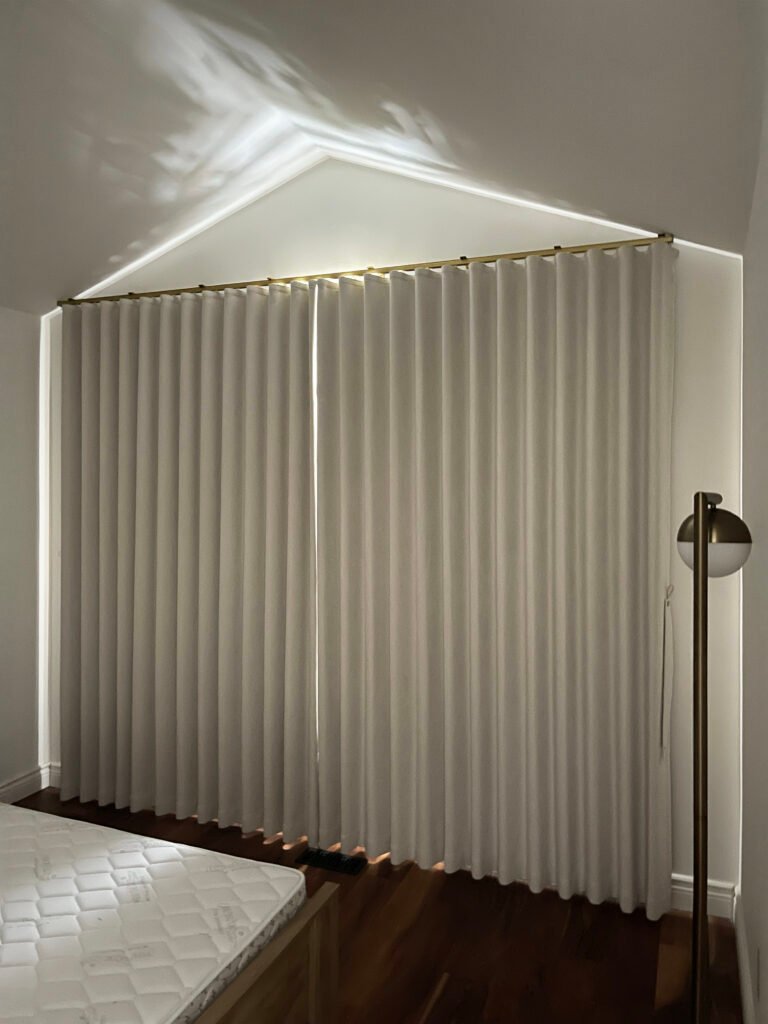
- Over the top. A curtain hanging from rings on a rod leaves a gap between the fabric and the wall. Daylight comes over the rod and washes down the wall behind the panels. In our experience it is the leak that catches people out most often, because it is the one you cannot see from the bed.
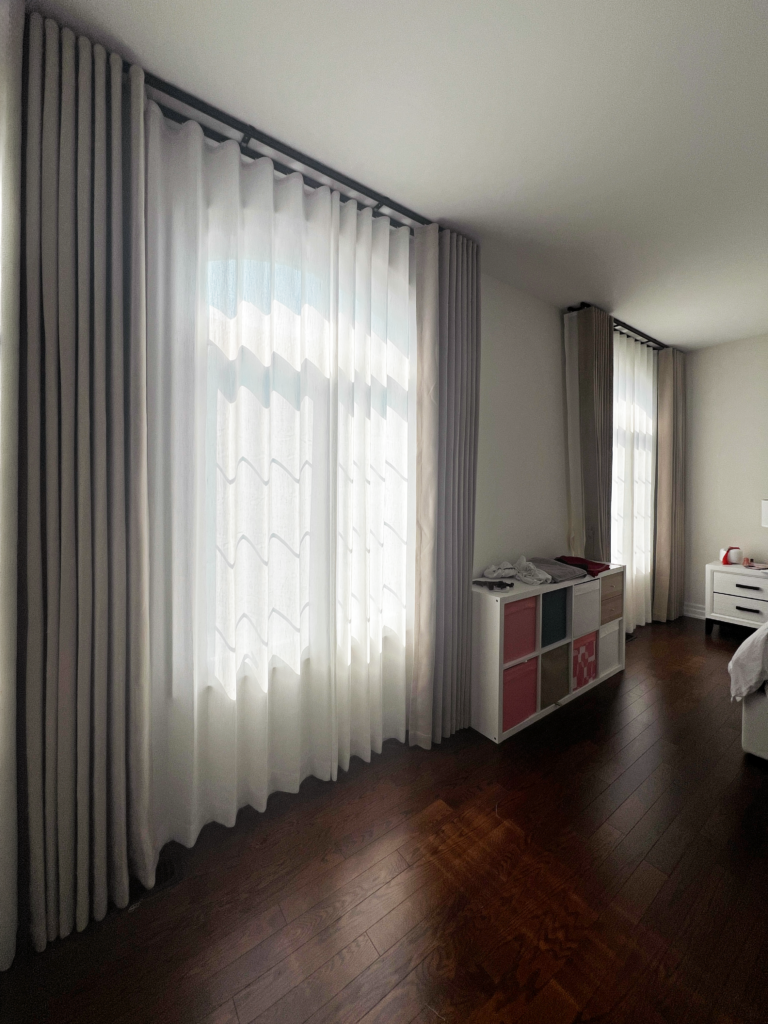
- Down the sides. Where the curtain ends, the wall begins — and if the panel stops flat, level with the window, there is a bright vertical line at each edge. The fix is a return: the fabric carries past the window and bends back to meet the wall, closing the edge.
- Up the middle. Two panels meeting in the centre will settle into a seam unless they are made to overlap. A pair that just touches will separate overnight.
- Along the floor. A curtain hemmed to hover above the floor leaves a bright band at the bottom. Length is a light-control decision here, not only a styling one.
Notice that three of the four have nothing to do with the fabric you choose. This is why a set of blackout panels can be perfectly good and the room still glows: the panels were solving one quarter of the problem.
What Closes Each Gap
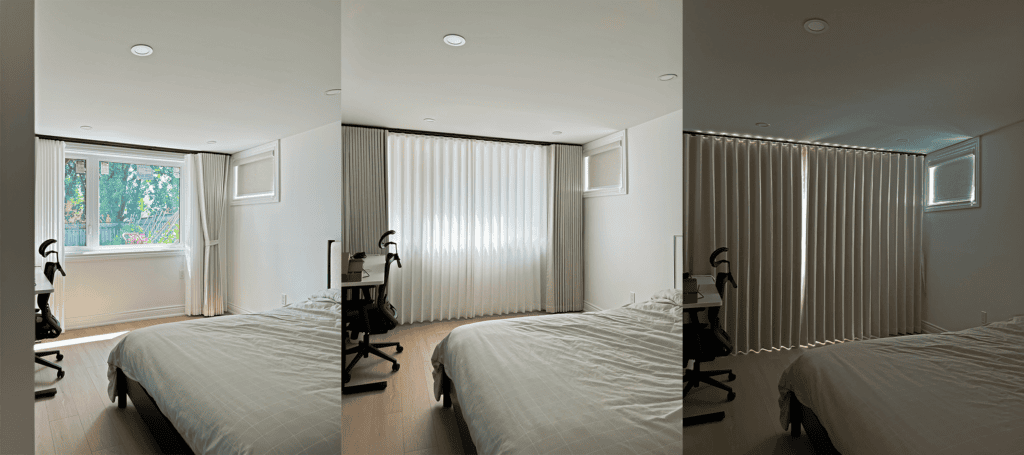
Every one of those four leaks has a straightforward answer, and the answers are decided at measuring, not at ordering. Mount high and wide. Taking the track well above the window and extending it past the opening on both sides means the fabric covers wall, not just glass. It closes the side gaps and, as a bonus, makes the ceiling read taller. Close the top. A ceiling-mounted track puts the fabric flat against the ceiling with nowhere for light to come over. Where a track isn’t right for the room, a wraparound rod that curves back to the wall, or a cornice above the curtain, does the same work. Build in the return and the overlap. Both are just extra width, decided in advance. On a pair of curtains, we specify the overlap at the centre so the panels close past each other rather than meeting edge to edge. Take the length to the floor. Breaking gently at the floor, or a fraction past it, removes the bottom band. It also means the curtain has to be measured against your actual floor — old Toronto houses are rarely level, and a hem cut to the wrong end of the window shows.
Blackout Lining: The Option Most People Are Never Offered
Walk into most shops and blackout is presented as a shelf of its own — a separate, limited set of fabrics you choose instead of the one you wanted. That is a retail constraint, not a physical one. Custom blackout curtains work the other way around. You choose the face fabric for the room — the linen, the velvet, the soft neutral weave that suits the bed and the walls — and the blackout layer is sewn behind it, out of sight. From inside, the curtain looks like the curtain you picked. From the window, it is opaque. Two things follow from that, and both are worth knowing before you shop. The first: the fabric almost never has to be the compromise. If a bedroom needs to be dark, that requirement lands on the lining and the mounting, not on your colour choice. The second: a lined curtain on a track that closes the top will generally darken a room better than an off-the-shelf blackout panel on a standard rod — because the panel is only solving the fabric, and the track is solving the gaps. The lining hangs with a bit more weight and body too, which is the part people notice when they see the two side by side.
Bay Windows and Awkward Openings
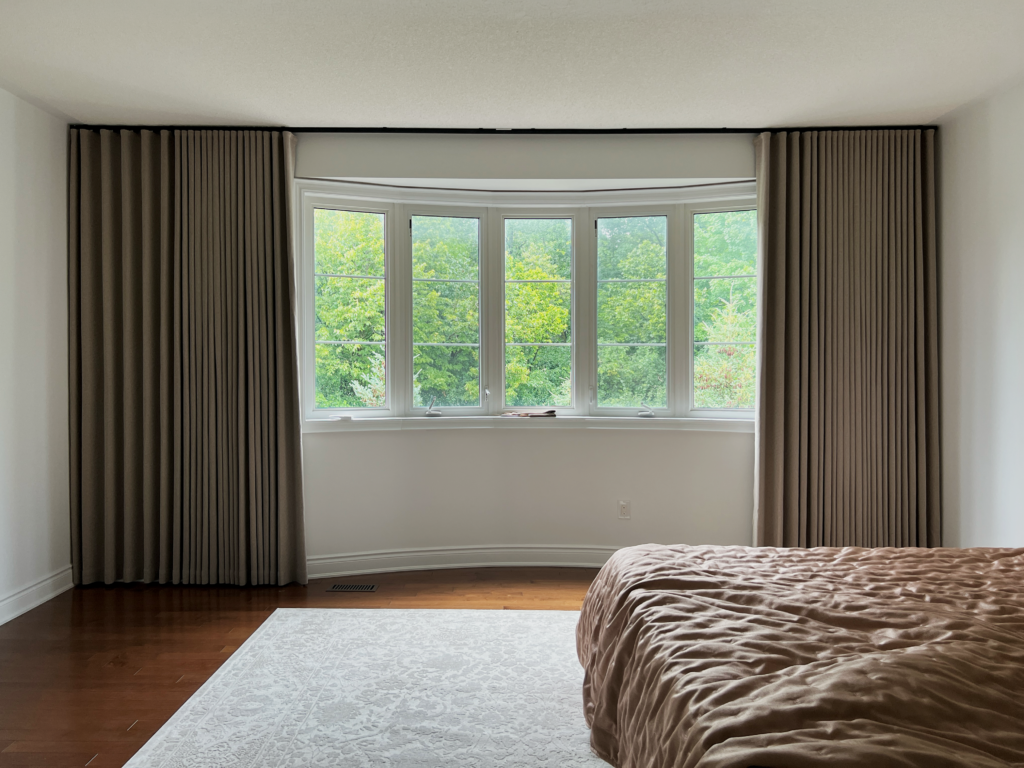
Bays are where this gets interesting, and they are common enough in Toronto bedrooms to be worth their own answer. A bay has corners, and every corner is a potential light gap. Three separate rods across three facets will leave two bright vertical lines where the sections meet, no matter how good the fabric is. A single track bent to follow the bay lets one continuous run of curtain pass around the corners, with a return at each end where it meets the wall. The same thinking applies to the other awkward ones: a window tucked beside a closet with no wall to spare on one side, a sloped ceiling, a window that runs almost to the corner of the room. Each has a solution, and each solution is about where the track goes rather than which fabric goes on it. If the bedroom window is unusually tall or wide, our guide to curtains for large windows and high ceilings covers the proportions in more detail.
Measuring for Genuine Blackout
An on-site measure for a blackout bedroom checks a different list than a measure for a living room. We measure the wall, not the window — because the curtain is going to cover more than the opening, and how much more depends on what is beside and above it. We look for what is in the way: a light fixture, a closet door that swings, crown moulding, a ceiling too shallow for a track. We check the floor along the whole width, since a floor that drops half an inch across a bay will show up as a wedge of light at the hem. And we take the return and the centre overlap as real measurements, written on the order, rather than leaving them to chance. Then we ask about the room the way you live in it. Which direction it faces, what time the sun reaches it, who sleeps there, whether they are up at five anyway. A nursery, a primary bedroom facing a streetlight and a spare room used twice a year are three different briefs, and they get three different answers. We bring samples and hold them against your own glass in your own light — a lining that looks neutral in a showroom can read cool or warm on a north-facing wall, and a bedroom is a room you see at every hour of the day.
Where to Start
If you are looking at blackout curtains for a Toronto bedroom, the first question is not which fabric. It is: how dark does this room actually need to be, and where is the light coming from? A bedroom that faces east at sunrise wants the top gap closed above all. A bedroom facing a lit street wants the sides. A child’s room may want room darkening rather than full blackout, so the space still feels like daytime at nap time. We measure across the GTA, and the rooms do differ. Blackout curtains in Mississauga usually mean a newer bedroom with a taller window, where the height is the interesting part — how far above the glass the track can go, and how much wall is left beside it. Older Toronto bedrooms tend to bring the opposite set of questions: shallower reveals, floors that are no longer level, and the bay window at the front of the house. Same four gaps either way; different ways of closing them. Our Mississauga window coverings page has more on how we work in that area. You can see the fabrics and constructions on our blackout curtains page, and the wider range of custom curtains in Toronto if the same room needs a daytime layer as well — sheer curtains on a second track are how most people get soft light by day and a dark room by night, from the same window. Or send us a photo of the bedroom window and tell us which way it faces. That, plus the time you would like to be waking up, usually narrows it to one recommendation. Book a free in-home consultation and we will measure the window properly, gaps included.