Reading the House First
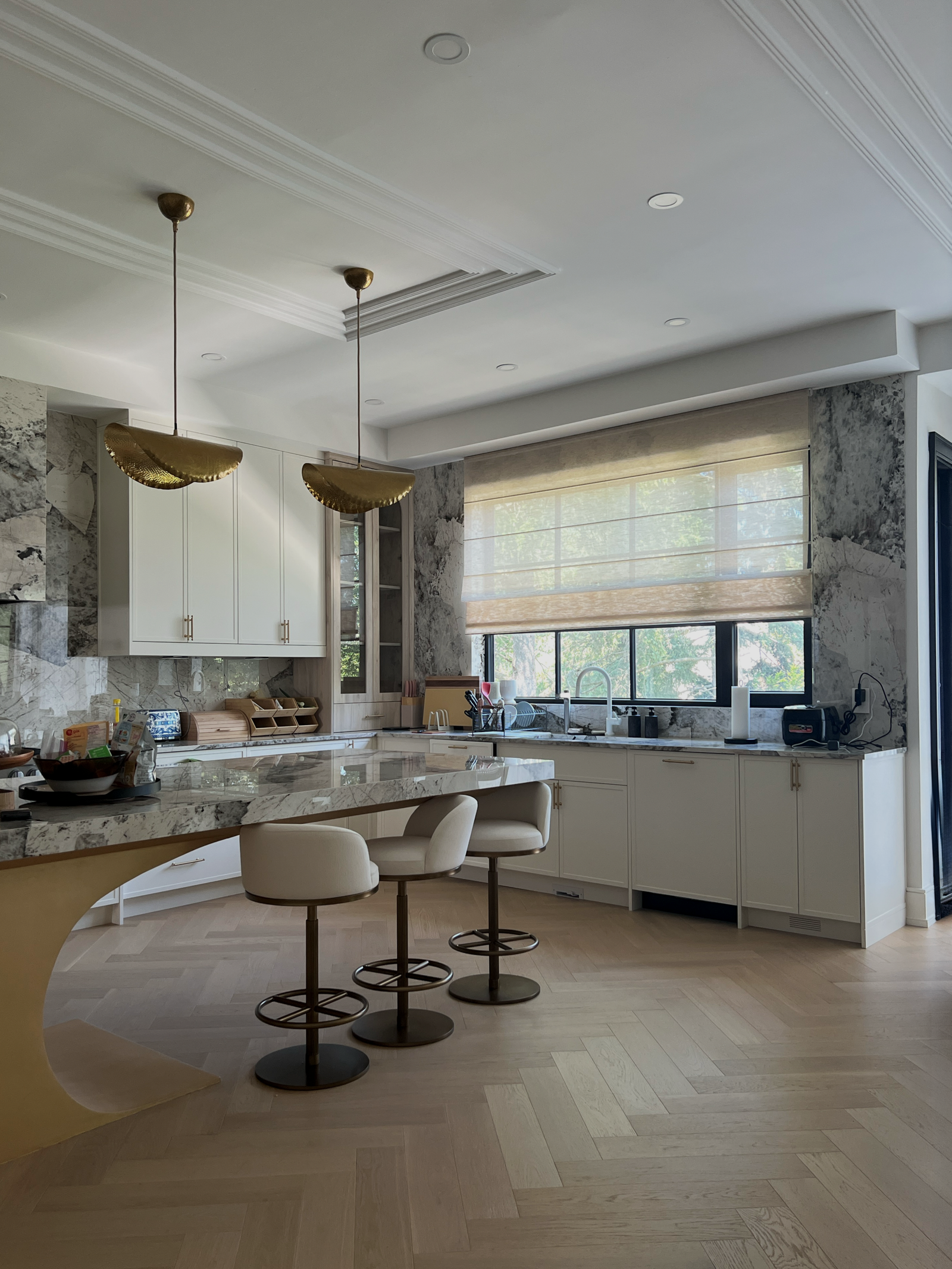
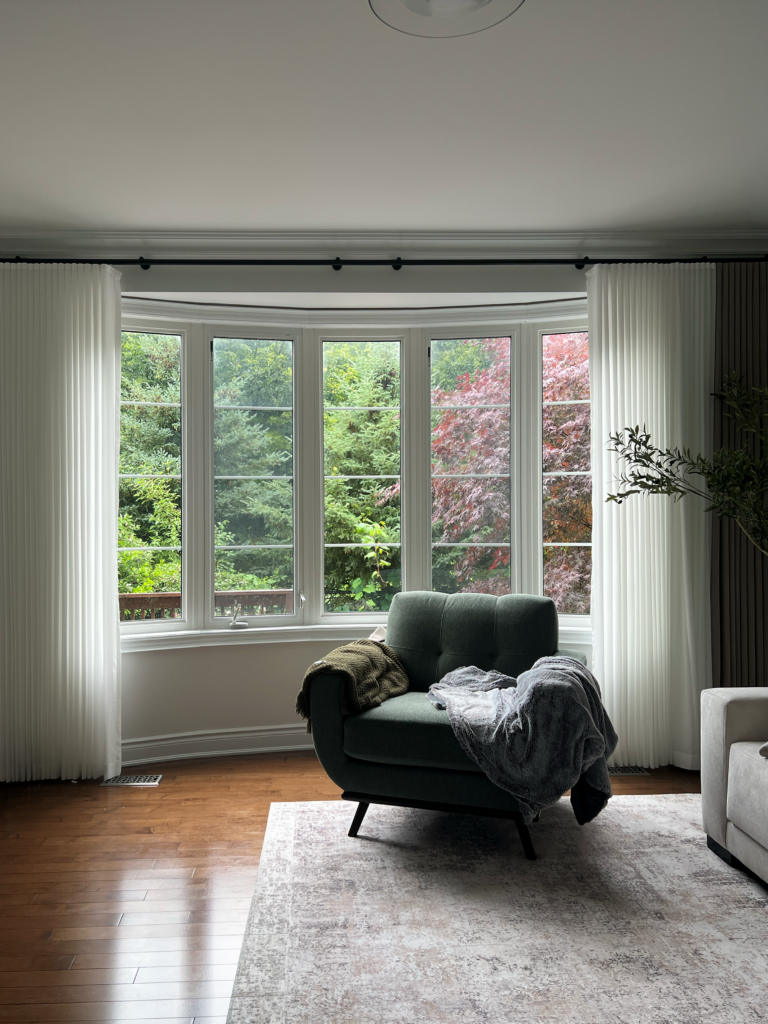
Before any fabric comes out, it helps to say plainly what kind of house you are in. This one tells you quickly. The ceilings in the bedrooms and the study are stippled — a sprayed texture you rarely see in a new build. The dining room has a coved ceiling with pot lights and a classical column at the opening. Upstairs there are cathedral ceilings with arched transom windows under the peak. Downstairs there are two bow windows, five panes each, curving out into the room. The ensuite has a corner tub with jets, a travertine-look tile surround and a bullnose chair rail. The kitchen millwork is cream. That is a traditional GTA family home, and a well-built one. Nothing about it is trying to be minimal. The newer layer pulls the other way: soft greige and warm white on the walls, matte black hardware, simpler furniture. So the house sits in the middle — traditional architecture, contemporary styling. Designers call that transitional, and window treatments are one of the few things that can hold both halves together, because they touch the wall, the floor and the light at the same time.
Why the Fabrics Are Brown, Not White
Here is the colour problem in one sentence: everything original in this house is warm, and everything new is cool. The hardwood carries a red-brown tone. The travertine tile is beige. The kitchen cabinetry is cream. Against those, the newer paint reads cool and grey. A pure white drape would have taken a side. It would have joined the new paint and left the floor stranded — and in a room with that much exposed hardwood, the floor always wins the argument. A cool grey drape would have done the same thing more quietly. The brown-neutral family does not take a side. Mushroom, taupe and soft coffee tones hold enough warmth to sit comfortably beside a cherry-toned floor, and enough grey to sit beside the walls. Stand in the primary bedroom and there is no visible seam between the old finishes and the new ones — the eye reads one warm room, not a renovation in progress. There is a second reason, and it matters more than colour theory. This house has lovely window shapes — the arches, the bow curves, the peaked ceiling. A quiet fabric lets the architecture be the feature; a brighter one would compete with it. So the drapery stays in that one brown-neutral family, the sheers stay a soft cream-white, and every rod and track is matte black. Consistent enough to feel deliberate room to room, with the exact shade chosen against each room’s own floor and walls.
Room by Room: What Each Window Actually Needed
Colour decides how a room feels. Function decides what goes on the window. These are the eight decisions in this house.
The Ensuite: Privacy Without Losing the Trees
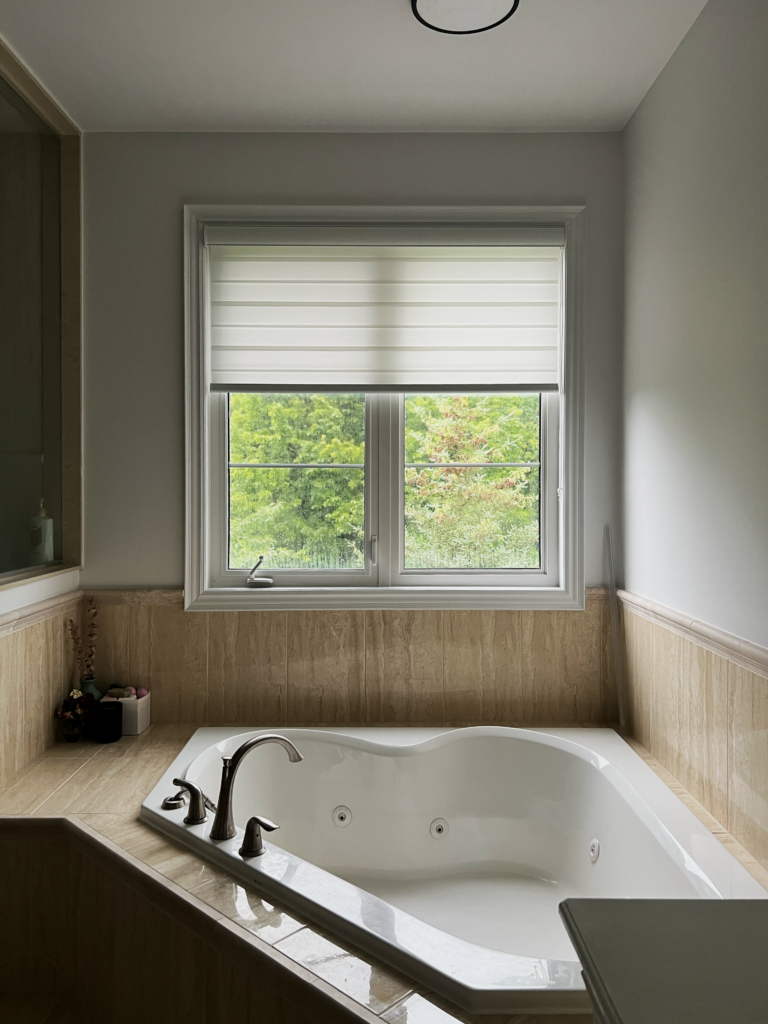
The tub sits directly under the window, and the window looks straight into mature trees. That view is the best thing in the room — and a bathroom still needs daytime privacy. A light filtering zebra blind answers both, because it has two positions rather than one. Align the fabric bands and you get a clear horizontal stripe of view. Offset them and the whole window turns into soft diffused light with no sightline in. You choose between view and privacy several times a day, not once at purchase. The fabric here answers to the travertine rather than the white trim. In a room where the tile takes up half the wall, the tile is what sets the colour.
The Second Bathroom: Same Product, Different Colour
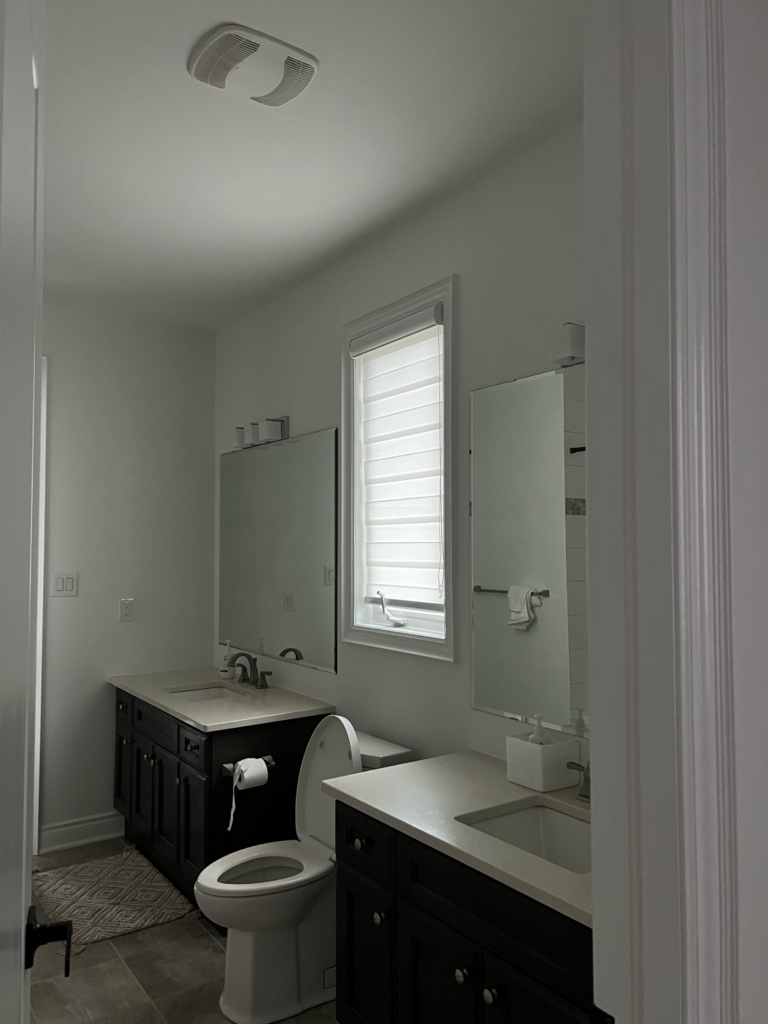
The shared bathroom is a cooler room — white quartz, espresso cabinetry, grey-white walls, no travertine. So the blind here is the same product in a whiter fabric. This is the part people often get backwards. Consistency across a house means making the same kind of decision in similar rooms, not buying the same swatch. Both bathrooms get a light filtering zebra. Each one gets the colour its own room asked for.
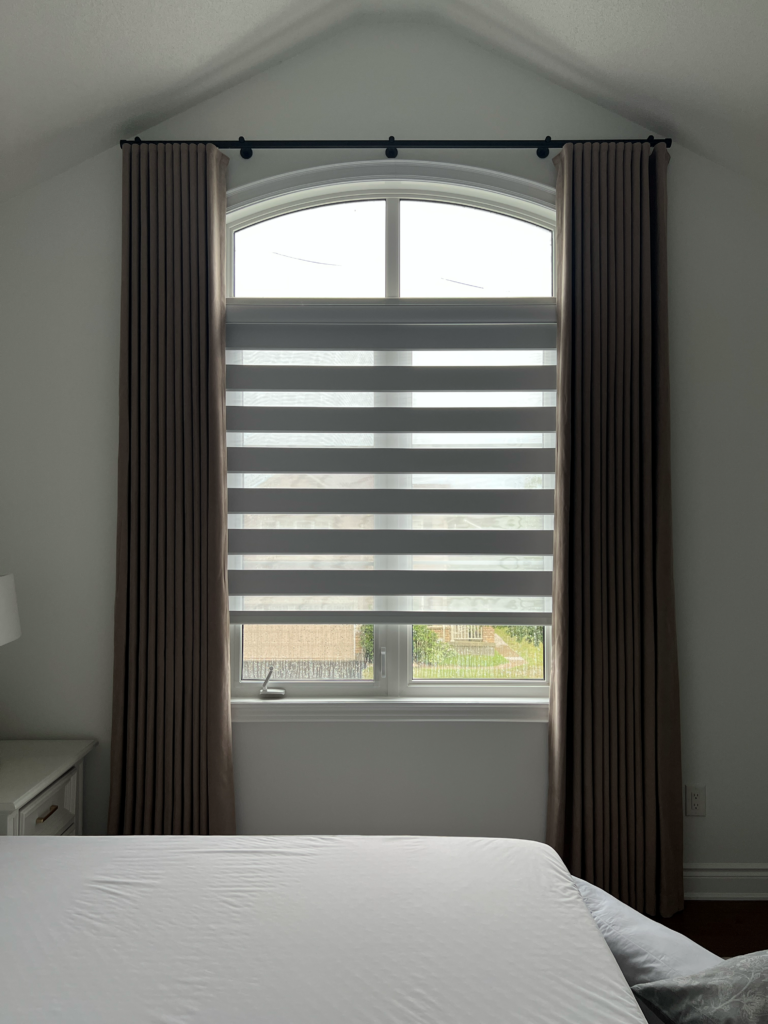
The Children’s Room: An Arched Window That Has to Go Dark
This is the hardest window in the house. An arched transom under a cathedral ceiling is lovely to look at and difficult to darken, because a blind can only square off at the straight part — whatever sits above the curve stays uncovered. So this window got two layers. A blackout zebra blind handles the rectangular opening and gives daytime control on its own. Blackout curtains on a rod mounted above the arch handle everything the blind cannot: the curved top, and the gaps at the sides where daylight otherwise runs down the wall. Drawn, the room goes properly dark. Open, the curtains stack off the glass so the arch is fully visible and the ceiling still reads tall. A child’s room needs both of those on the same day.
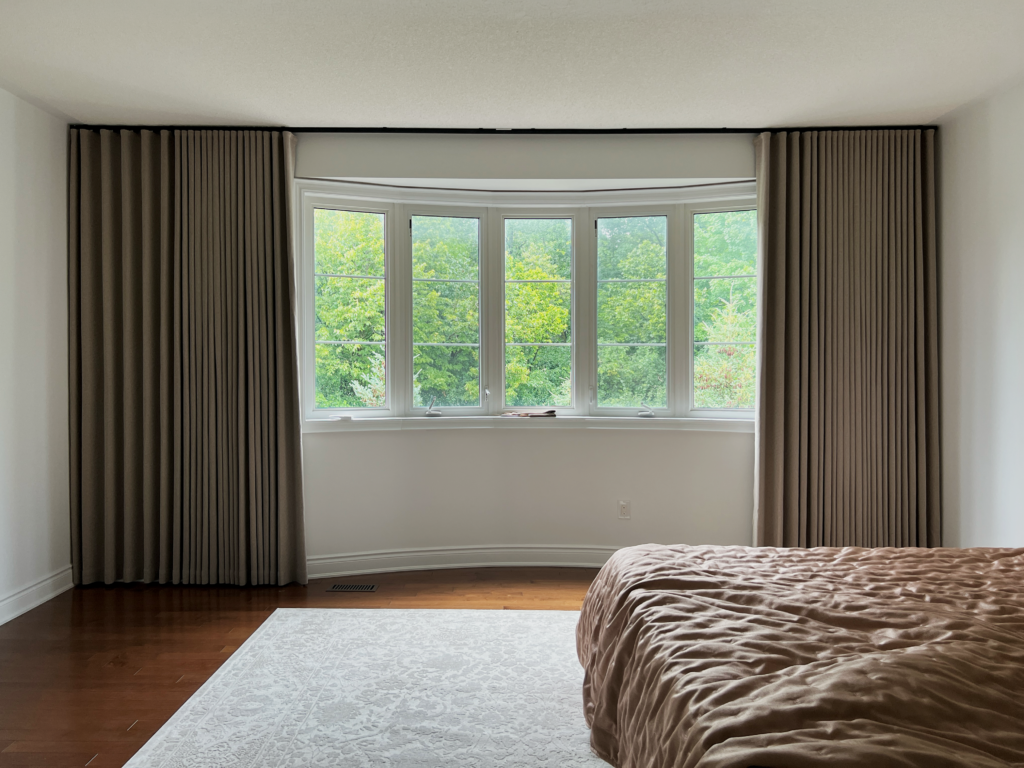
The Primary Bedroom: A Bow Window on a Curved Track
The fabric follows the bow as one continuous run, and because the track sits at the ceiling rather than above the window, there is no gap over the top for morning light to spill through — the leak most people never think to close. It also carries the eye upward, so the room reads taller than its ceiling height. Open, the panels stack onto the wall at either side instead of over the glass, so the window is never narrowed by its own drapery. That stacking space is decided at measuring, not at ordering.
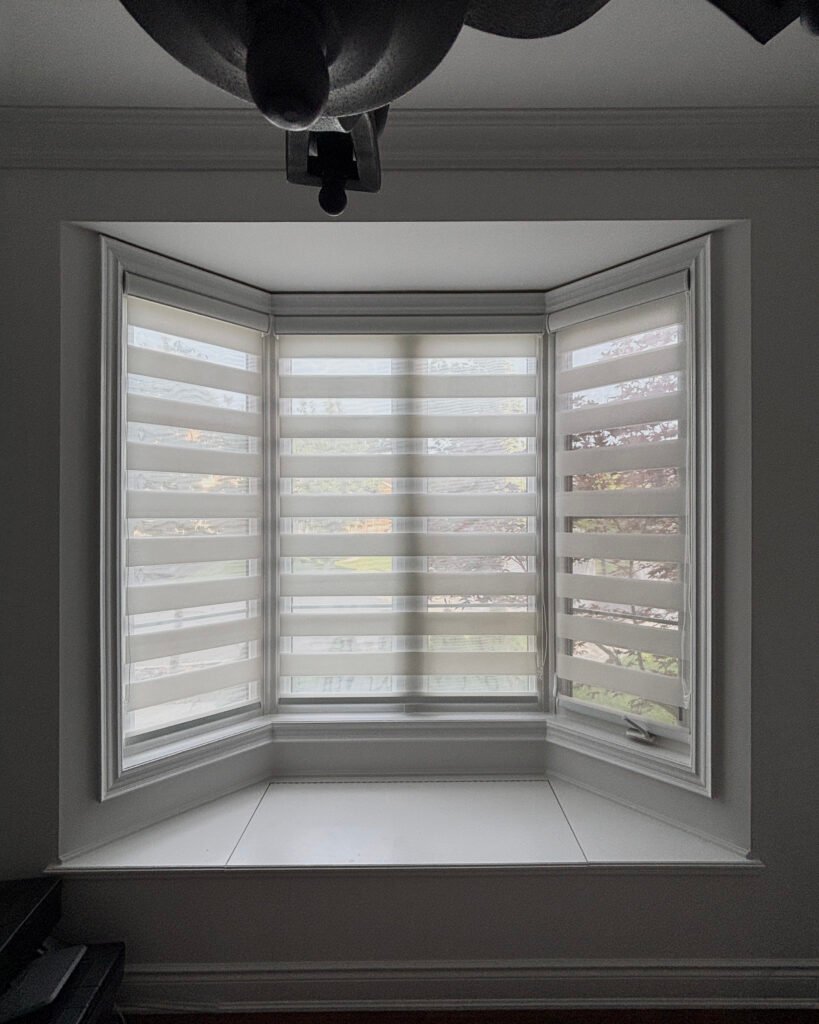
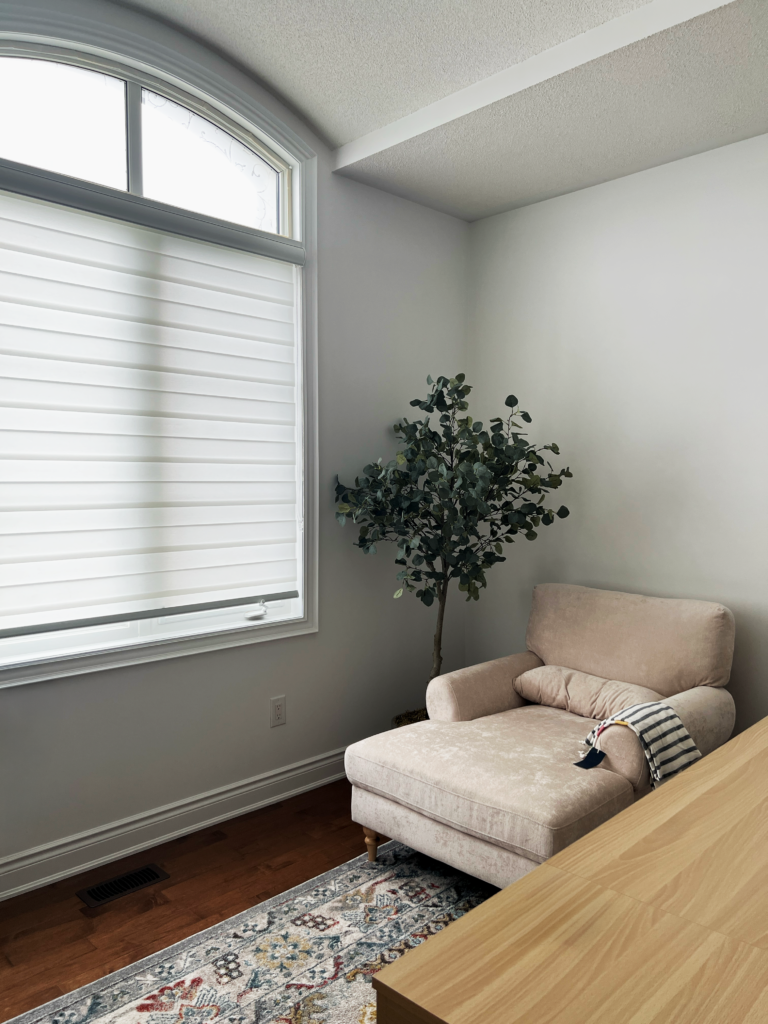
The Study: Light You Can Work In
study has the opposite brief to a bedroom. Nobody wants it dark; they want the glare off a screen without turning the lights on at two in the afternoon. Light filtering zebra blinds do that well. Lowered with the bands offset, a bright window becomes an even, soft panel of daylight — the harsh contrast that tires your eyes disappears, but the room stays lit. The bay took three separate blinds, one per pane, each measured to its own opening. Bays are rarely as symmetrical as they look, and the difference between three blinds that line up and three that nearly line up is entirely in the measuring.
 ” —
” —
The Dining Room: A Sheer That Turns the Bay Into a Lantern
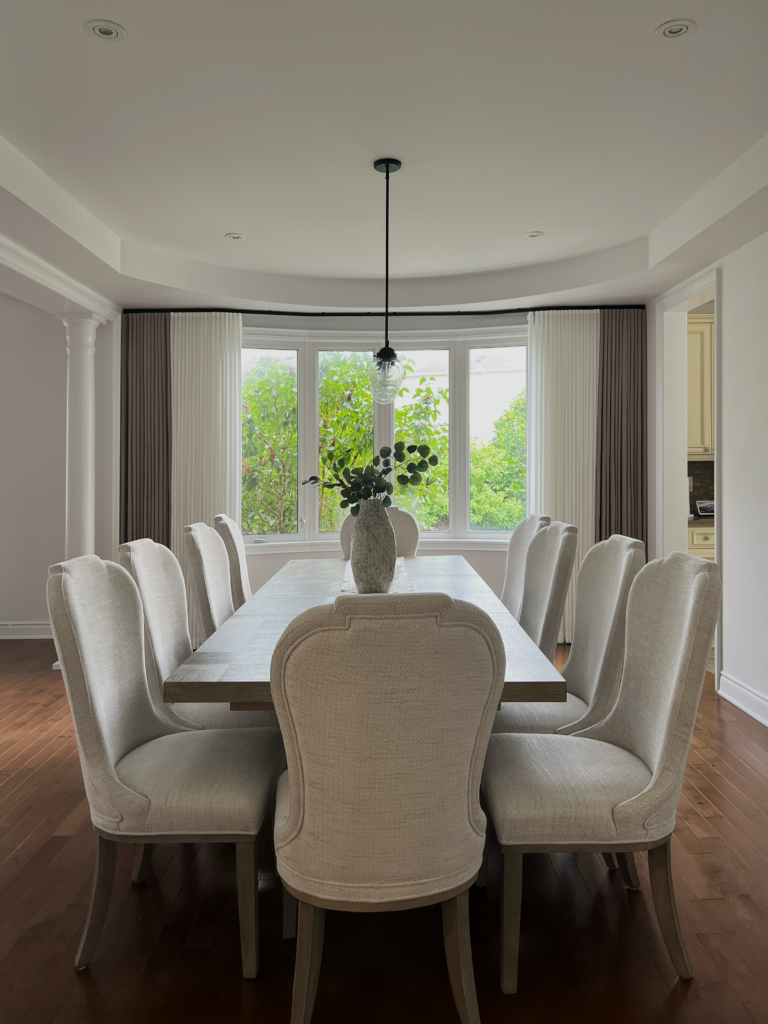
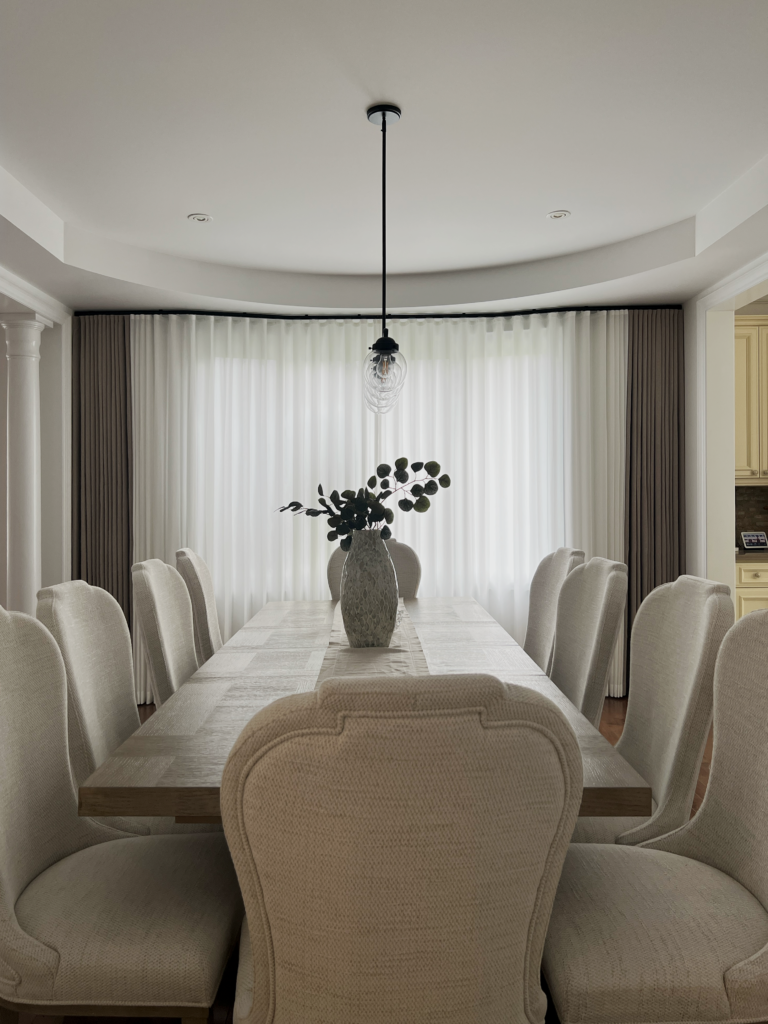
The dining room bow sits inside a coved ceiling, with a column marking the opening. Formal architecture deserves a formal answer. A single layer of sheer runs the full curve on a curved track. Drawn across, it does something a photograph shows better than words: the whole bay becomes one soft panel of light, and the coved ceiling above reads like a lit alcove. Nobody needs privacy at dinner here, so the sheer is doing purely optical work. The taupe panels at each end are decorative. They do not traverse — they frame the window, give the fabric run a beginning and an end, and repeat the brown-neutral tone from upstairs so the house holds together.
The Living Room: Two Narrow Windows and One Bay
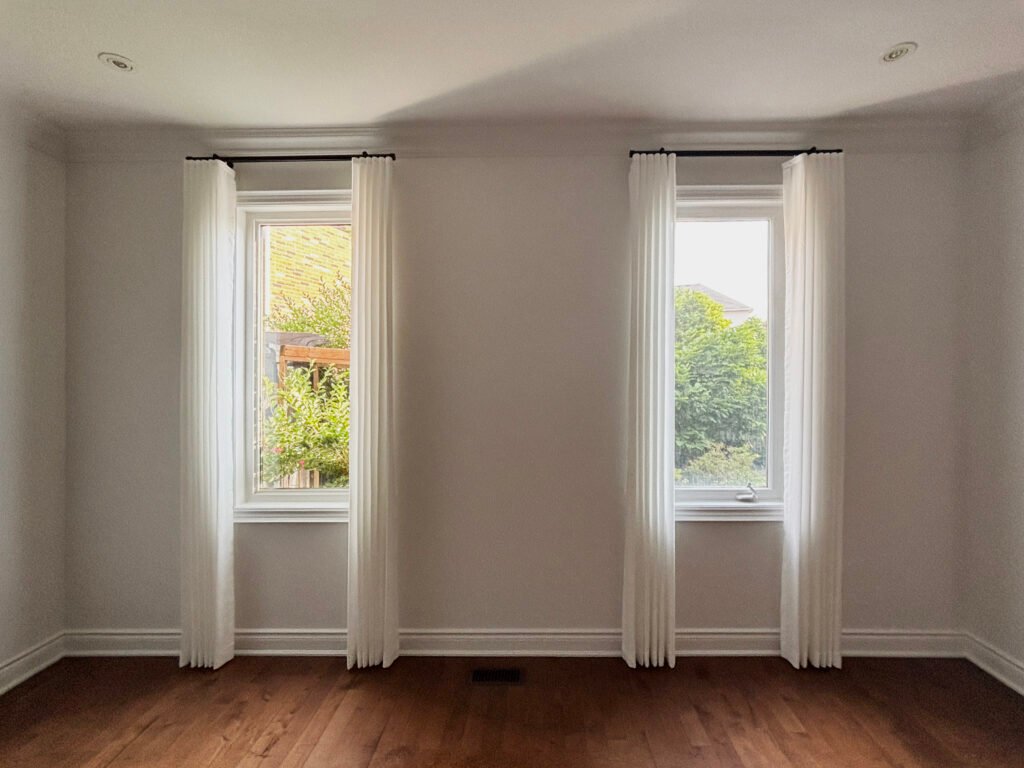
Two narrow windows on a wide wall are an awkward pair — left alone, they read as two small holes. The sheers here are mounted high and extended well past each frame, so the fabric covers wall as well as glass. Each window reads wider and taller than it is, and the pair sits in balance.
What to Take From This House
Five things, if your own home has a few years on it.
- Match the fabric to the finishes you are keeping. Floors, tile and millwork set the temperature of a room long before paint does.
- A bridging neutral beats a bold one in a transitional house. Taupe, mushroom and warm greige let old and new finishes sit together instead of arguing.
- Arched and bow windows need the mounting solved, not just the fabric. Curved tracks, ceiling mounts and rods set above the arch are what make those shapes work.
- Let each room state its own requirement. Blackout in bedrooms, light filtering in bathrooms and studies, sheer where the view is the point.
- Consistency is a shared approach, not identical swatches. Same thinking in similar rooms, colour chosen room by room.
If You Are in Milton
Milton is full of houses like this one — established detached homes on their second or third round of updates, with bow windows, arched transoms and cathedral ceilings that standard sizes were never made for. We measure all of those on site, because a bow that is a few degrees off, or a floor that is not quite level, changes what can be built. You can see what we do in Milton, browse custom blinds and shades and custom curtains, or simply send us a photo of the window you cannot work out. A free consultation is the easiest place to start — we come and measure, and you get to hold a few fabrics up against your own floor. As this house shows, that is usually the moment the decision makes itself.